Ninety percent — that’s how much of the Bay Area’s tidal wetlands have been lost to humanactivity in the last 150 years, according to the San Francisco Bay Conservation and Development Commission.
From the development of factories and shipyards to encroachment of suburban sprawl, local wetlands have paid the price for the Bay Area’s role as an economic powerhouse.
The Napa River’s delta, with its muddy sloughs and sinuous waterways that attract migratory birds and are home to several endemic aquatic and mammalian species, is one of the Bay Area’s last relatively intact wetlands.
At the edge of these wetlands, a former American Canyon city yard is being repurposed into the Napa River Ecology Center — a 3‑acre hub for watershed education, citizen science and nature access that’s already 75% funded.
“It’s all about the Napa River watershed, and that doesn’t really exist right now anywhere in the valley,” said Janelle Sellick, the executive director of the American Canyon Community & Parks Foundation, in an interview with the Register.
The foundation spearheaded the project — which will be located at 205 Wetlands Edge Road at the intersection of W. American Canyon Road — with support from the American Canyon community.
“The project was in such a great location because we’re right here at the mouth of the Napa River, the American Canyon wetlands, as part of the Southern Napa River watershed,” she said. “It allows opportunities for citizen science that are really unique and not found anywhere else in the valley.”
To close the remaining gap on the $9 million project, organizers have launched a mosaic tile mural campaign that lets community members leave a permanent mark on the center’s walls.
The mosaic, which will be executed by Vallejo artist Rachel Roadie, will feature ceramic tiles with donor names etched into them, integrated into the mural as a legacy.
“A lot of our work is reflected by or in honor of nature and culture,” said Roadie, who spoke with the Register.
Roadie said she emphasizes the importance of educating younger generations about environmental stewardship. She will be collaborating with her partner and fellow artist, Guy Forte, on the project.
The project’s “primary motivation,” Roadie explained, is twofold: “One is to recognize major donors who are giving to the renovation in the new ecology center, and then second, it was to create a beautiful artwork that inspired the visitors… a creative way to recognize donors that not only just has a bunch of names, but has like beauty and respect for the wetlands in a media that has longevity.”
In the final design, tule grass will be front and center, with donor names formed from handmade ceramic tiles woven into the reeds.
Tiles prices vary by size and design. For $500, donors can claim a small 2-3 inch tile added to the mosaic design, which can include up to three initials and/or stamp. At $1,500, donors can add their name to the 12-inch by 12-inch square plaques adorning the left side of the mural and weaving into the tule reeds. The $5,000 tule tiles are 23 inch by 5 inches and “capture the gentle movement of river reeds and grasses.” And for a generous $10,000, donors can add their name to the 36 inch by 8 inch long river tiles which make up the largest presence on the mural.
“We work to bring delight, bring joy, bring awareness through creativity of the natural world,” Roadie said. “The more you see and are aware of [the animals and their habitats], the more you learn to notice them and respect them.”
The American Canyon Community & Parks Foundation hopes to raise the remaining funds for the project via the mosaic mural campaign before construction of the center breaks ground in early spring.
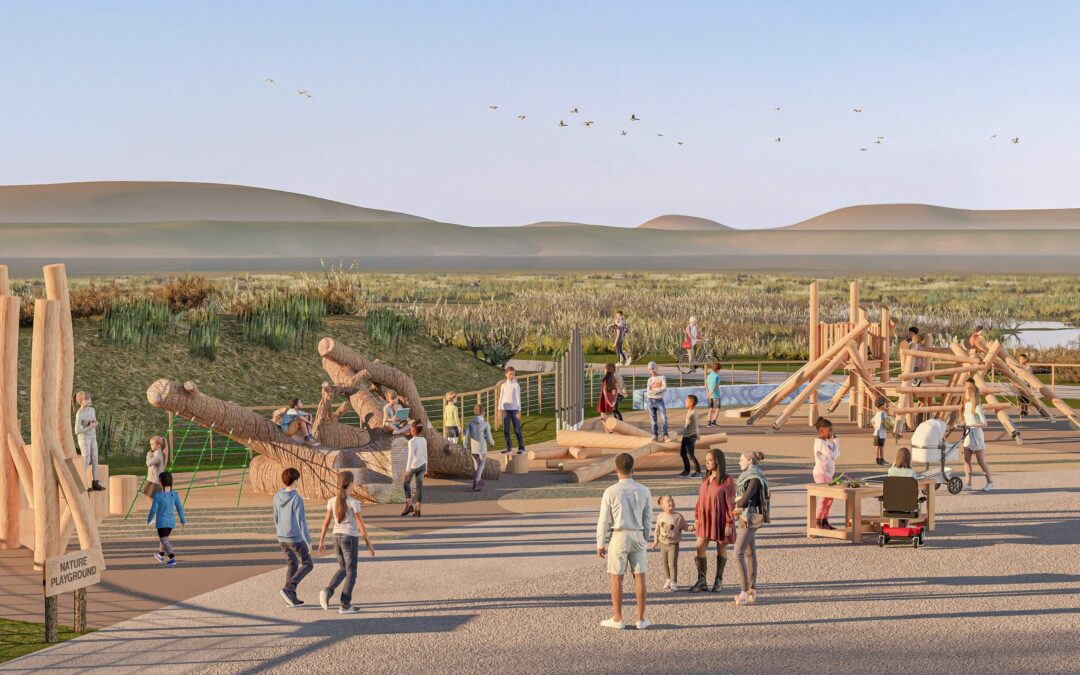
When completed, the center will include outdoor classrooms, gardens, and a nature-based playground, with a focus on watershed and wetlands education for youth, adults and families, as well as citizen science opportunities.
“We had a growing demand for education and watershed conservation programs,” Sellick said.
The center’s slogan is “One River, One Goal, One Community.”
Sellick emphasized that the center will utilize the existing 5,000 square-feet building on the property, which is being repurposed (not demolished) as part of the ethos on sustainable reuse.
The center is designed as a large indoor–outdoor classroom with big glass doors that can be opened on most days, creating a seamless experience for visitors.
The classroom will offer lessons and gatherings, as well as group programs. In addition, an environmental artist workshop using repurposed shipping containers will be available for environmental art activities.
Outside, there will be a teaching garden with raised garden beds to teach kids where food comes from; a pollinator garden featuring native plants and pollinators; a nature-based playground for children; and community gathering areas in the back, suitable for events.
And what would a wetlands-focused ecology center be without direct access to nature?
Sellick said there will be an elevated wetlands viewing deck (about 20 feet high) with nearly 180-degree views toward Marin, Highway 37, Mount Tamalpais and Mount St. Helena.
She also noted that the center’s location incorporates what she called, “passive nature” access: walking, wildlife and bird viewing, sunset watching, and a second access point to the wetlands to relieve the existing trailhead.
“People are really wanting access out to the wetlands… to walk, view the wildlife, and watch the sunset,” she said.
For Sellick, educating future generations through art and hands-on interactions with these ecosystems is invaluable work.
“We’re looking forward to helping to create the next generation of stewards of our environment,” she said.
To donate to the mosaic mural campaign and claim a named tile, visit acparks.org/napa-river-ecology-center/mosaic-mural.
To make a general donation to the capital fund, visit acparks.org/napa-river-ecology-center/capital-campaign.
By Brett Marsh