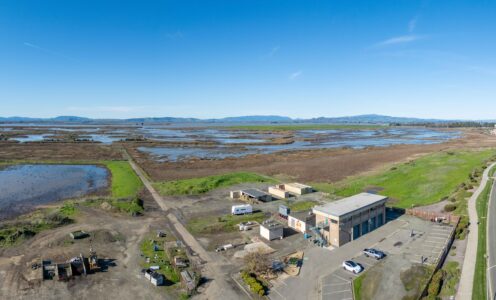
AMERICAN CANYON, Calif. — The first thing that struck me on site was the contrast: an aging industrial building set against a working wetland that still behaved like a living system. A few feet beyond the fence line, tidal water moved through channels and tule stands. In the distance, egrets and avocets worked the mudflats. The Napa River wetlands, long treated as back-of-house space for infrastructure, were now being framed as the front door.
Janelle Sellick, executive director of the American Canyon Community and Parks Foundation, walked me through what she described as a four-year effort to turn a former public works corporation yard into the Napa River Ecology Center, a year-round base for watershed education and community programs. The foundation, a 501(c)(3) nonprofit, spearheaded the project.
“This is a story of revival,” Sellick said. “There’s a history of misuse where people used to come and dump trash in the river and run amok out here, and that’s now changed. The wetlands were used, then restored and now they’re being valued.”
The project site sits at 205 Wetlands Edge Road, on a 3-acre parcel with an existing 5,000-square-foot building. Sellick said the building dated to 1989. Before the city used the site as its public works yard, she said, it supported county water treatment operations tied to wastewater infrastructure that once discharged into treatment ponds in the wetlands. Over time, those ponds were restored to tidal wetland, with wastewater flows routed to a permanent treatment plant elsewhere.
The current plan is straightforward in concept and complex in execution: Reuse what can be reused, remediate what has to be fixed and open the site to the public in a controlled, program-driven way rather than as an unfenced park. Sellick compared the future site to Connolly Ranch in Napa — a facility with structured programming, steady school use and scheduled public access.
“It’s not like a public park,” Sellick said. “We’ll have programs almost daily during the week, most likely school groups. This provides a home base.”
A Program That Grew Without a Home
The project grew out of a constraint Sellick returned to repeatedly: Demand for hands-on watershed education outpaced the foundation’s ability to deliver it without infrastructure.
Sellick said the parks foundation began 10 years ago as a grassroots organization, founded by volunteers who “started out with $0 in the bank” and focused on “supporting parks, open space, getting community connected with nature.”
The gap they found was not interest. It was access.
“What we learned was there was a real interest in having hands-on education opportunities,” Sellick said. “We’re here on this amazing wetland, but it wasn’t always very accessible.”
Sellick said a $50,000 grant from Napa Valley Vintners in 2018 helped fund early curriculum development with the Napa County Resource Conservation District. The first pilot launched as COVID-19 hit. The foundation shifted content online, then returned to field-based programming as restrictions eased. The watershed programs expanded into multiple grade cohorts and formats: Watershed Trainees (K-3), Watershed Explorers (fourth grade), Watershed Protectors (fifth grade), Wetlands Academy (seventh grade) and summer programs delivered through a mobile classroom.
Joy Hilton, the foundation’s education program director, provided a snapshot of what that growth looked like in numbers.
“Since we started the program in 2020-2025, we have served 3,600+ students and delivered over 9,800 hours of environmental education,” Hilton wrote in an email. She said those totals include Watershed Explorers, Watershed Trainees, Watershed Protectors, Wetlands Academy and summer mobile classroom programs.
She said the foundation uses pre- and post-testing in the fourth-grade program.
“In general, about 10-30% of students can answer our questions correctly before our program,” Hilton wrote. “This number increases to 80-97% of students answering correctly after the class.”
Her description of what worked was less about a single lesson and more about what happened when students were placed in an environment that demanded attention.
“Kids are sometimes reluctant about being outside in the wetlands, but when you get them to see and hear the nature all around them, they connect and make better observations than most adults,” Hilton wrote.
She said some students stayed with microscopes and specimens far longer than adults expected.
“One fourth grader didn’t want to leave the mobile classroom where she was examining specimens under the microscope,” Hilton wrote. “‘This is so great, I feel like a real scientist, I don’t want to stop,’” the student had said.
In another example, Hilton described a fifth-grade field day tied to invasive plant removal.
“One fifth grader said, ‘I thought this was going to be boring, but it’s fun. Who knew 10-year-olds could make such a difference?’ after his class helped remove over 2,500 square feet of ice plant,” Hilton wrote.
Teachers saw the same pattern: science moved from abstract to lived experience.
“The watershed program is so important because it makes learning meaningful and real for our fourth graders,” wrote Nanette Sauceda, a fourth-grade teacher with Napa Valley Unified School District. “Instead of only reading about the environment, students get to see firsthand how water systems work and how everything in a watershed is connected.”
Sauceda said her students rotated through stations that included water testing, bird observation and journaling.
“The program helps them develop a sense of responsibility and pride in caring for the Napa Valley watershed and the place they call home,” she wrote.
From Yard to Education Center
The Ecology Center is an adaptive reuse project: a 5,000-square-foot building and three-acre site that will shift from city industrial use to a year-round base for watershed education, conservation programming and scheduled public access. Sellick said the plan includes indoor and outdoor teaching areas, wildlife viewing, gardens and demonstration features tied to sustainable practices. The point is not to open a new park, she said, but to create a staffed, program-driven facility that makes the wetlands teachable at scale.
The city provided the site through a long-term lease of $1 per year for 50 years, Sellick said. The foundation led the design and engineering beginning in 2022 and moved through value engineering as construction-cost estimates climbed.
Jason Holley, city manager of American Canyon, said the project advances the city’s strategic priorities.
“The Napa River Ecology Center Project advances key priorities in American Canyon’s Strategic Plan by transforming a city-owned industrial site into a hub for environmental education, stewardship, and connection to the Napa River wetlands,” Holley said.
Holley said the city’s contribution extended beyond the lease itself. He cited long-term site control, the nominal $1-per-year lease and more than $1 million in cash and in-kind infrastructure work, including stormwater and flood protection improvements.
The project also sits inside a broader set of public access plans along the wetlands. Holley said the city was planning a kayak launch immediately adjacent to the Ecology Center site. A feasibility study included in the city’s wetlands restoration plan appendices evaluated three potential launch locations, including the area next to the Ecology Center.
“Immediately adjacent to the Eco Center on the western edge of the site, the City is planning for a kayak launch which is anticipated to be funded through a Measure AA grant,” he said.
On the construction side, Sellick said the plan was on track.
“It’s a $9 million project,” Sellick said. “We just went out to bid, and our bids came back within our project estimates.”
She said the foundation had raised about $7 million and expected to break ground in the spring if it closed the remaining gap. Construction was projected at roughly one year.
To close that last stretch, the campaign combines grants, donations, naming opportunities and a public-facing mosaic installation that functions as both donor recognition and a specific funding lever. The mosaic wall is planned inside the building, framed by glass roll-up doors, with donors sponsoring tiles that become part of a permanent work.
“The mosaic wall will be both an art piece and a way to acknowledge donors,” Sellick said.
Federal Support, Then a Budget Whiplash
Large capital projects rarely fail because the vision is unclear. They stumble because financing is a moving target, especially when part of the stack depends on federal appropriations that can shift with a single budget cycle.
Sellick said the foundation secured $800,000 in federal support in 2024 through congressionally directed community project funding, with Rep. Mike Thompson’s backing. A larger tranche — $2.5 million anticipated in 2025 — was later removed from the budget under the new administration, she said, leaving the project to bridge the gap through additional fundraising, grant strategy and local partnerships.
“It hurt,” Sellick said. “You just have to keep getting creative. And having Congressman Mike Thompson championing the project has been a huge help.”
In a written statement provided to Napa Valley Features, Thompson said the center will expand hands-on watershed education while strengthening community stewardship of local ecosystems.
“Once complete, the Napa River Ecology Center will provide exceptional educational resources to our local students and will help our Napa County community to conserve our local ecosystems,” he said. “Students, researchers and local nature-lovers alike will get the chance to participate in watershed conservation efforts, scientific studies, wildlife and environmental programming, and nature art opportunities.
“This project is a big win for our community,” Thompson continued. “I’m proud to have already secured $800,000 in federal funds to support the development of the Napa River Ecology Center, with more money on the way in this year’s congressional appropriations process. I’m grateful to the American Canyon officials for identifying the need for these funds.”
Why It Matters Now
Late in the interview, I asked Sellick why she believed the project mattered in 2026, beyond the standard case for environmental education. Her answer shifted from logistics to psychology.
“We’re in a place right now where we all need something really positive and hopeful to look to,” Sellick said. “This is a place where people can connect with nature and walk 50 feet out there and refresh themselves with this natural environment that has a story of hope and revival.”
She described the wetlands not just as scenery but as infrastructure that becomes more valuable as climate volatility grows. She referenced recent king tide observations and the role wetlands play in absorbing water, protecting shorelines and storing carbon.
“The wetlands that surround us act as this giant sponge,” she said. “The more we protect and restore and care for them, the more they’re going to mitigate the effects of sea level rise and climate change.”
The foundation is also operating within an existing pattern of heavy public use on nearby trails. Sellick said there are about 10 miles of publicly accessible trails in the wetlands area. In a follow-up email, she said she had heard an estimate of roughly 7,000 visitors per month at the nearby Wetlands Edge trailhead.
Hilton framed the urgency from another angle: the operational reality of field-based education without a facility.
“What’s the biggest operational constraint today without a dedicated facility?” Hilton wrote.
Her list was direct and familiar to anyone who has run outdoor programs at scale: weather, transport, setup time, storage, restrooms, safety and capacity. The Ecology Center, she said, changes that immediately.
“The Eco Center is a game-changer,” she wrote. “I can see our programs being able to serve more students from Napa County and beyond. This site could be part of other environmental education programs run by our partner organizations. We will be able to host open houses so everyone can come and learn about the local environment. We will be able to host meaningful adult education classes and events, as well.”
What Comes Next
If the project closes its remaining funding gap, the next visible milestone is construction, then the slower work of scaling use. Sellick said the foundation already runs programs across multiple grades, plus a Teen WILD cohort of 25 teens each year who lead conservation projects and help teach younger students. Hilton said those teens are eager to share the work publicly.
The bigger bet is cultural: that a former industrial yard can become a place where a child learns how a watershed works, a teenager learns how to lead a restoration project and families can experience the wetlands as something more than a backdrop.
Sellick described the goal as building future stewards.
“Through this site, we’re building the future stewards of our environment and our future leaders,” she said. “We all need a place like that where people can come and thrive.”
The wetlands do not need the Ecology Center to exist. They have persisted through misuse, restoration and redevelopment pressure. What the Ecology Center proposes is a different kind of relationship: not just access but understanding that is reinforced over time.
For a county that often talks about the Napa River as a defining feature, the project attempts something concrete: making watershed literacy part of what growing up here looks like — not an elective experience, not a one-off field trip, but a baseline.
—
Tim Carl is a Napa Valley-based photojournalist.